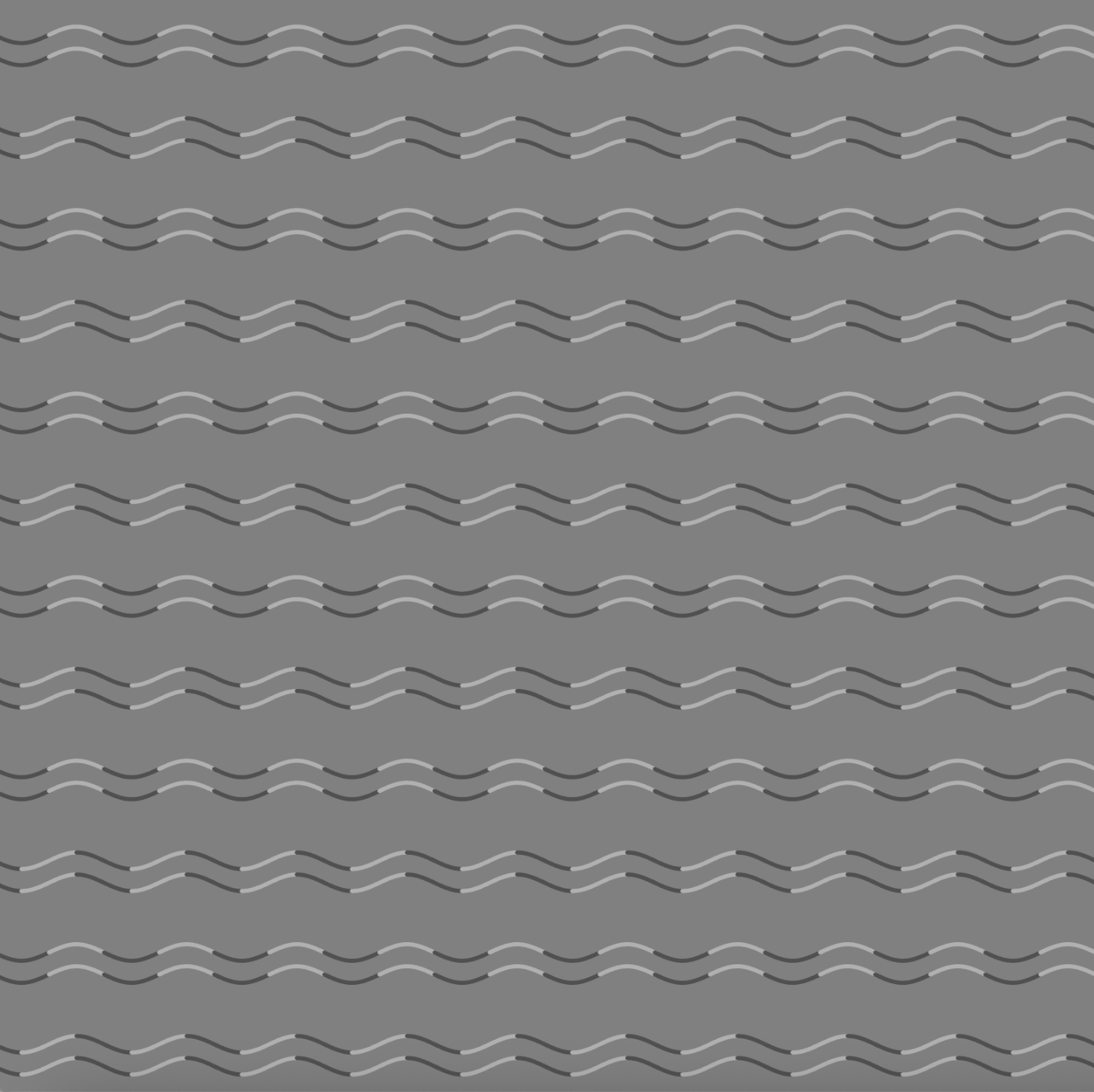
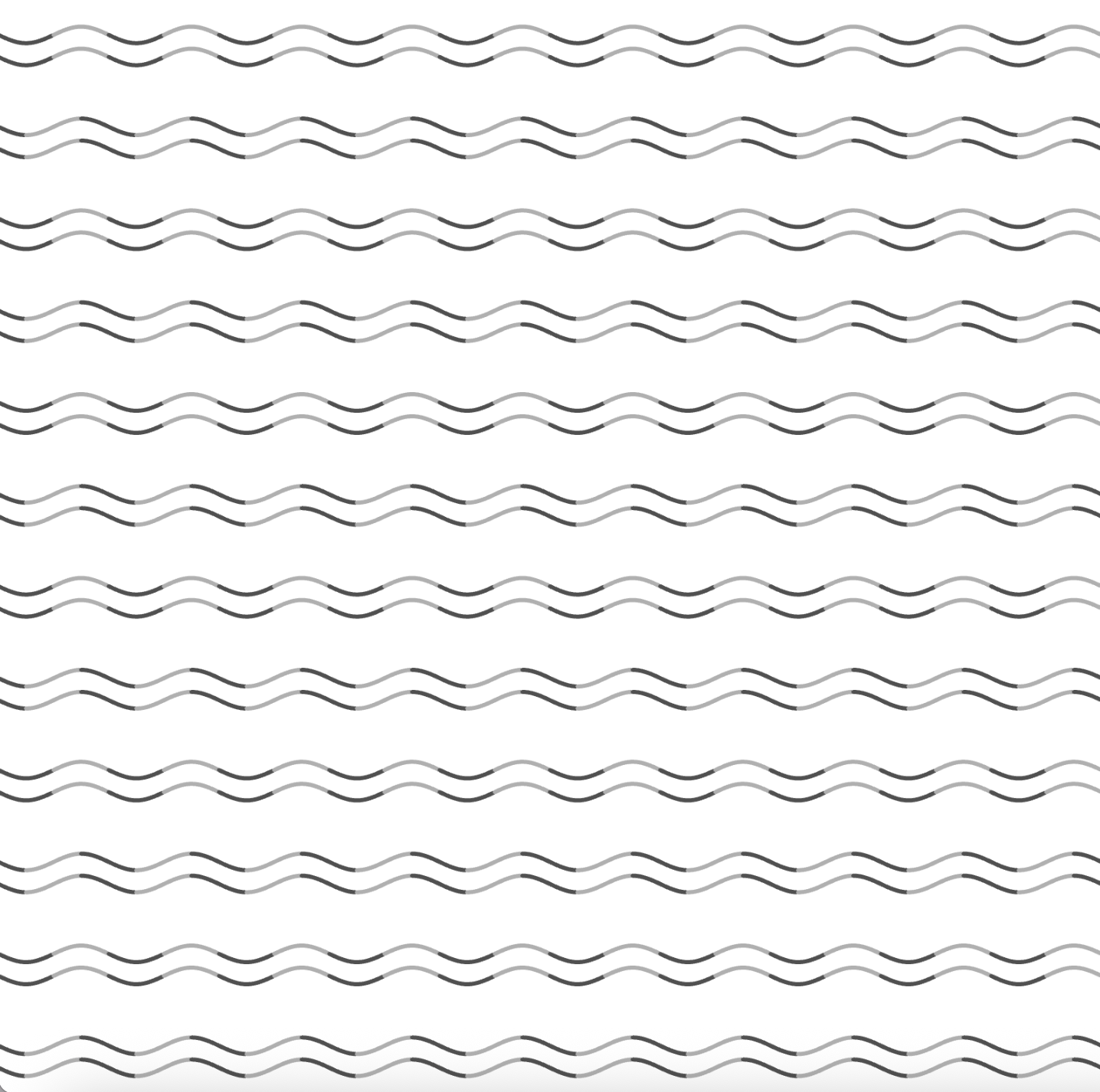
In the Curvature Blindness Illusion, gently curved lines appear angular, creating the illusion of a zigzag line. The lines themselves are all identical, smooth curved sine waves, but some portions of the lines are darker while others are lighter, creating a visual fragmentation of the array which is crucial in generating the illusory experience (Takahashi, 2017).
Takahashi (2017), who discovered and popularised the illusion, identifies two factors that contribute to the illusory effect. The first has to do with colour polarity. Colour polarity refers to the difference in luminance between a pattern or display and its background – in this case the differently coloured line-segments and their background. ‘Positive’ polarity refers to a dark pattern on a light background while ‘negative’ polarity refers to a light pattern on a dark background (Buchner and Baumgartner, 2007).
According to Takahashi, the Curvature Blindness Illusion only occurs when the segmentation is produced via a reversal of polarity compared to the background. This is what happens in the image above, which we may call the ‘grey condition’. In the grey condition, the background is darker than the lighter segments and lighter than the darker segments. A light segment against the grey background is thus an instance of negative polarity, while a dark segment against the grey background creates positive polarity. Therefore, alternating dark and light segments against the same grey background results in repeated reversals of polarity. Polarity changes from positive to negative and then back to positive and so on throughout the array.
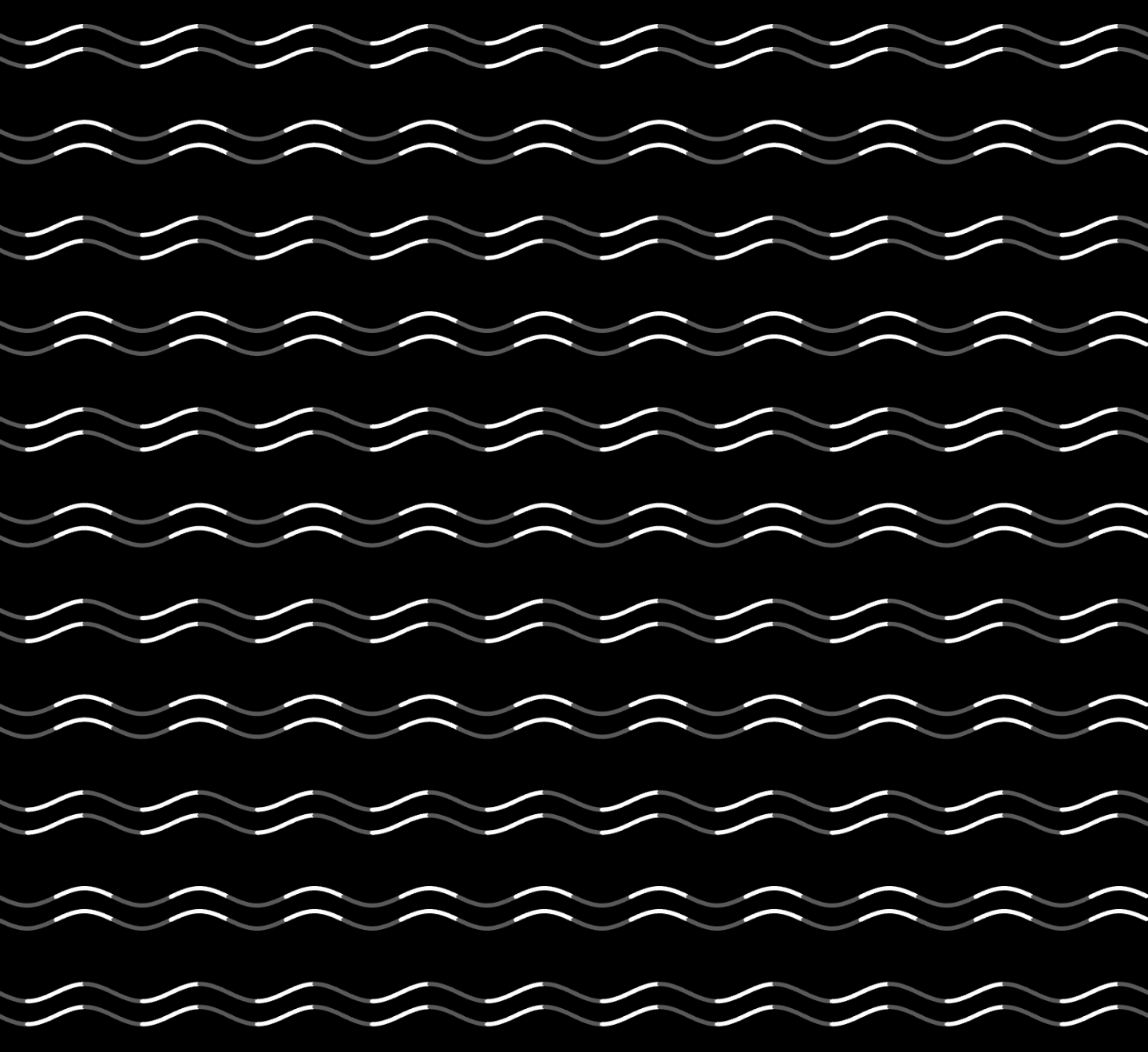
This does not happen when the background is white, given that the lighter and darker line-segments are both darker than the white background, meaning that no polarity reversal can occur. This explains why a change in the background (which can be seen by hovering the cursor on the image above) changes how we perceive the lines. Anderson and Burr (2018), however, have argued that the illusory effect can be produced even when no polarity reversals occur. They agree with Takahashi that the illusory experience is strongest when there are polarity reversals, and that a white background delivers a particularly weak effect. Even so, they argue that the illusion can be produced, although more weakly, on a black background where, again, no polarity reversals occur. Verify this for yourself in the image below:
The second factor identified by Takahashi (2017) is the location of the fragmentations in the sine wave, that is, the points at which the lighter segments end and the darker ones begin, and vice versa.
You will notice that fragmentations occur at different points in the alternating pairs of lines. In the lines that are perceived veridically as curved, each segment stretches between two consecutive inflection points of the sine wave. In other words, the change from darker to lighter segments (and vice versa) occurs at the points where the sine wave goes from concave to convex (or vice versa). In the lines that generate the illusory experience, fragmentations are instead placed between two consecutive turning points. This means that light and dark fragments alternate at the point where the sine wave stops increasing and starts decreasing and vice versa.
A related issue raised by Takahashi (2017, Experiment 3) concerns the influence of information about depth and shadowing. In the lines that are perceived as angled, the darker segments can be interpreted as being in the shadow, whereas the lighter segments appear to be illuminated. The pattern in the misperceived lines is consistent with the shadowing that would be generated by a singular light source shining from the upper left corner of the image. As Takahashi highlights, these cues about shadowing might be interpreted as providing depth information which would be consistent with a zigzag line, rather than a curved one. Indeed, the changes from segments that are illuminated to those that are in the shadow are abrupt, which is what would happen in a zigzag contour, and not gradual as they would be if the contour were smooth.
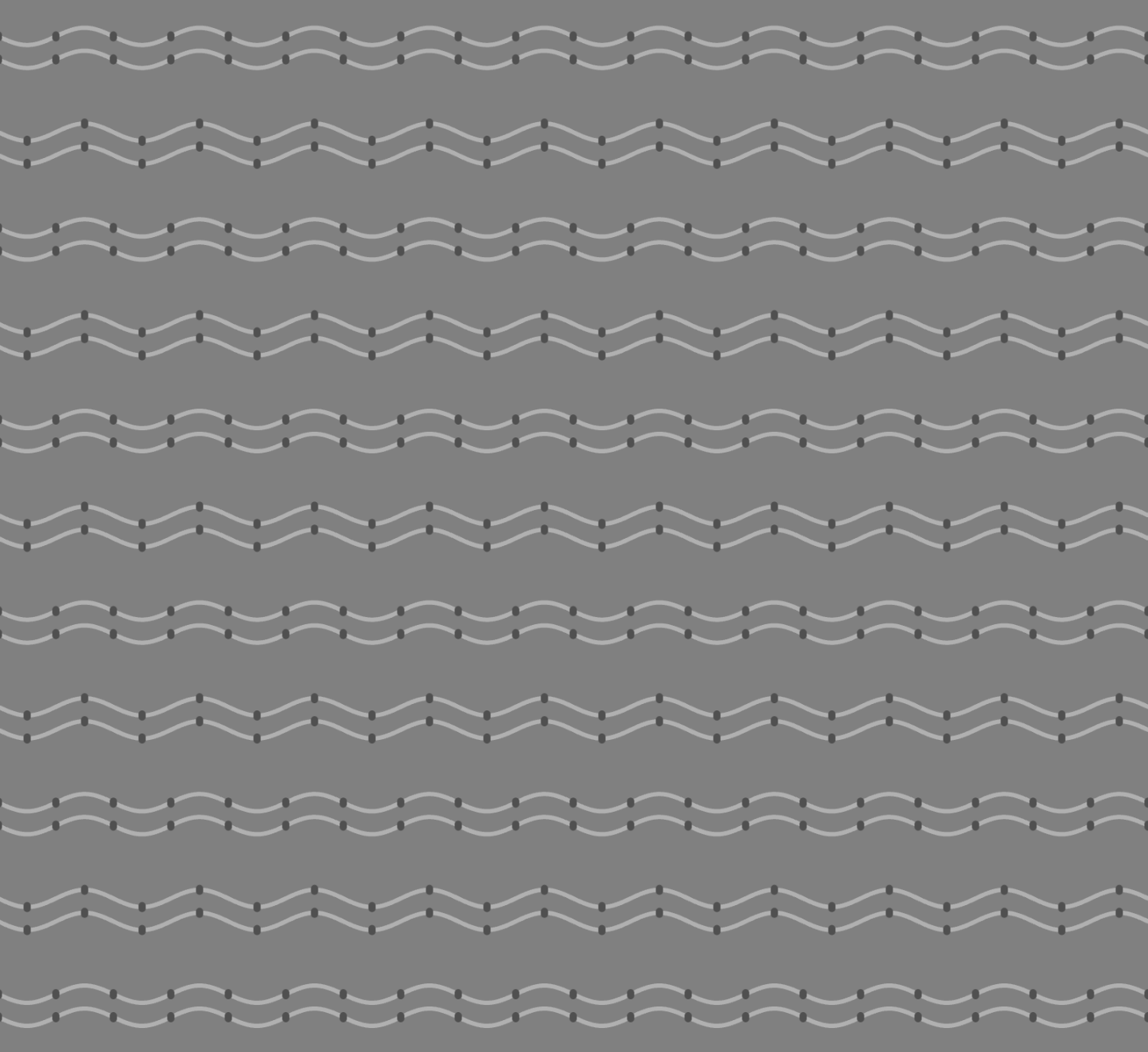
Takahashi (2017, Experiment 3) however, argues that this depth information is not crucial to generating the illusion. This is because the illusory effect can be obtained even when depth information is absent. To see this, look at the image below, where the darker fragments are replaced by dots placed at the turning points of the sine wave. The illusion should persist.
As both Takahashi (2017) and Bertamini and Kitaoka (2018) hypothesise, it is fragmentation of the line that is playing the determining role in generating the illusory experience. The visual system, they argue, can only detect orientation at discrete locations, and curvature is derived as a global property by integrating local information about orientation (see also Blakemore and Over (1974) on the topic). On this interpretation, the curvature blindness illusion shows how minimal segmentation, even a dot, can disrupt curvature perception. For Takahashi, this suggests further that corners are in some sense the ‘default’, while curvatures can be perceived only once the visual system reaches some threshold of evidence. Other phenomena, such as the Coffer Illusion, may similarly showcase the phenomenon of corner dominance.