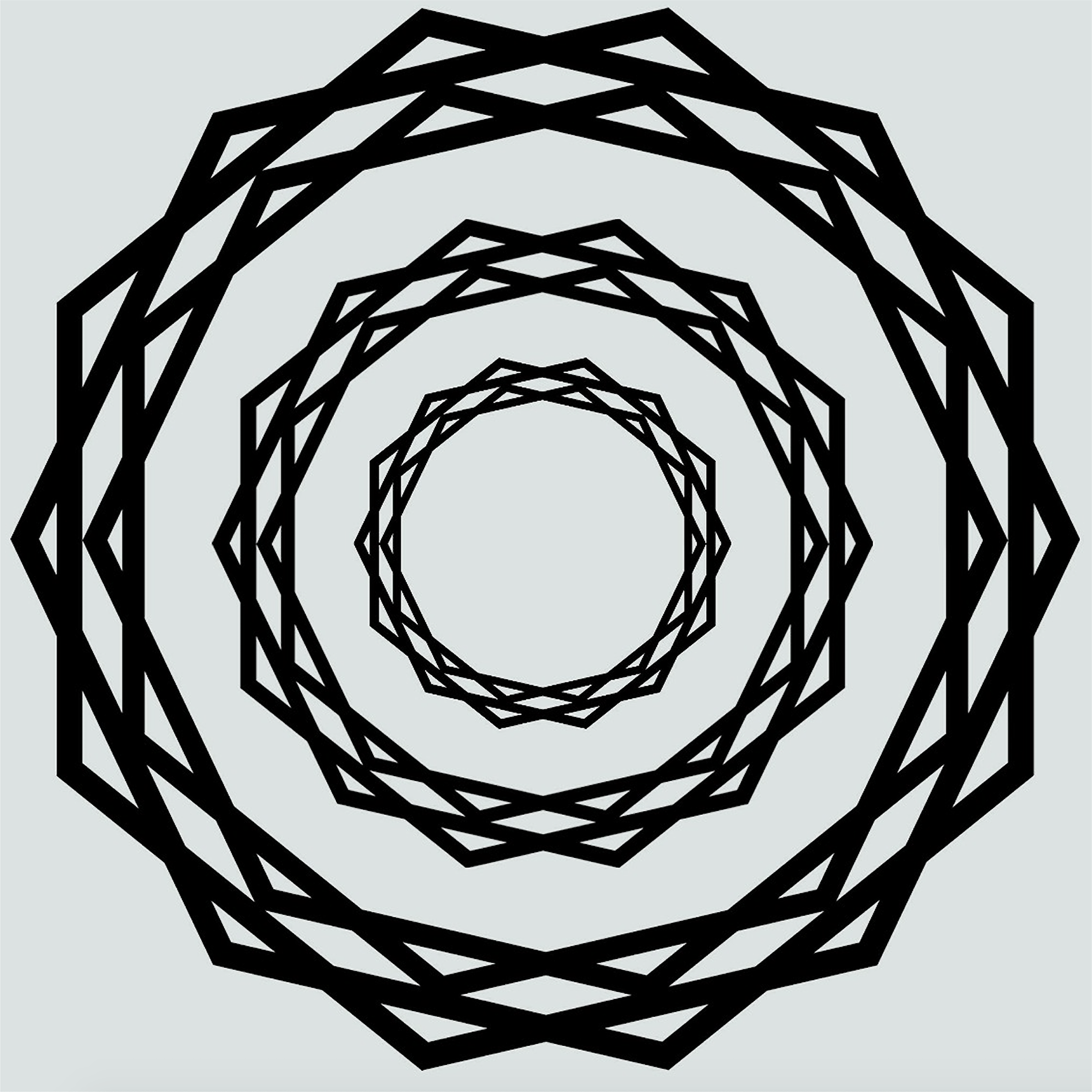
In the Scintillating Starburst illusion, bright rays appear to be radiating from the centre of the image, even though they are not physically there (Karlovich & Wallisch, 2021).
The Scintillating Starburst is an example of a "compound illusion", where several different effects combine to create the overall impression of scintillating rays emanating from the centre of the wreath. Another example of a compound illusion is the lilac chaser (which can be seen on Michael Bach's website).
In their explanation of the scintillating starburst, Karlovich and Wallisch (2021) identify three key effects. First is a contrast effect. Look at the point where the black "wreaths" that make up the image intersect. The visual system interprets these black intersections as brighter, as there is less of a contrast effect with respect to them compared to the black lines that form the rest of the wreath. There is less white around the areas of intersection of the black lines than the black lines that are not intersecting. This resembles what we experience in the Hermann Grid illusion.
Second, because these bright spots line up in straight lines, our peripheral vision connects them, and our perceptual experience represents them as bright light rays. Karlovich and Wallisch (2021, p.12) argue that the visual system’s ‘best guess’ about what is causing the arrangement of isolated bright points that are interpreted as being in the image is that there are solid light rays actually occluding the intersections. As in the Kanizsa Triangle, we may think that this is a case of our visual system rejecting ‘coincidence’, in the sense that an arrangement of isolated bright spots perfectly lined up as in the scintillating starburst is unlikely in the natural environment. A similar retinal stimulation is more often caused by one continuous surface, and so this is how the ‘rays’ in the scintillating starburst are represented by our perceptual system (see Rock and Anson (1979) for discussion).
Third, the rays seem to shimmer or "scintillate" because another part of the visual system (foveal vision) does not interpret the intersection points as brighter, causing the rays to appear and disappear. The shimmering effect, is, in the words of Karlovich and Wallisch, the result of a ‘dynamic competition’ between the opposing guesses made by foveal and peripheral vision (2021, p.13).
Considering the above explanation, we may wonder whether the scintillating starburst is best thought of as a case of illusion at all. Philosophers of perception sometimes distinguish between three kinds of perceptual experience: (i) accurate (veridical) perception of the world; (ii) illusion (a kind of non-veridical perception in which we perceive an object but experience it as having one or more properties that it does not); and (iii) hallucination (in which one has a perceptual experience but, nonetheless, having it does not amount to perceiving the world) (Macpherson 2013). The scintillating starburst illusion is partly due to what vision scientists call simultaneous lightness contrast. In relation to similar cases, like the Hermann grid, philosophers have pointed out that it is not clear whether to best classify these as an illusion or as a kind of hallucination (Byrne 2011; Macpherson 2013). The question is whether we are inaccurately perceiving the points where the wreaths intersect (and so undergoing an illusion), or whether we are hallucinating the appearance of non-existent rays. According to the explanation given by Karlovich and Wallisch (2021) it appears that we are doing both; misperceiving the intersection points as brighter (the first effect above) and hallucinating the rays that connect them (the second effect above).
Finally, it is interesting to note how various features of the wreaths modulate the strength of the illusion. Karlovich and Wallisch (2021) found that the number of wreaths in the image, as well as the line width of each ‘braid’ and the number of vertices in each polygon all influenced how strongly the illusory rays were perceived.